

Flow Concepts was approached last year to act as team flow coach for the members of Solar Team Eindhoven. It is very nice to see how they strive to maintain a team flow climate and we are very curious how the elements from the Team Flow Model are reflected here. Therefore, we asked two team members to share their experience with us.

Carijn Mulder, Team Manager, Solar Team Eindhoven 2019
”I am Carijn Mulder, team manager of Solar Team Eindhoven. In doing so, my job is very versatile. The team consists of 26 team members, including 21 engineers and five more management positions. My function in that is team management, but there are four other functions. Project management, two positions for acquisition and another person on PR. And I’m basically the flying keeper for all those four positions. So, the moment something is left behind somewhere, I’m the one who is deployed for that. Apart from that, another important part of my function is that I keep an eye on the team dynamics and that everyone can work together in a smooth way and that there are no frustrations within the team that stop the whole flow of the team.”
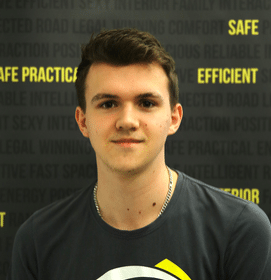
Yvo Elling, Driver Support Systems Engineer, Solar Team 2019
”I am Yvo Elling. I’m 20 years old and I’m on Solar Team Eindhoven. I’m a Driver Support Systems Engineer. So that’s supporting the driver of the car. And since September we have been working on that. I’m behind the computer a lot. As a software engineer, of course you spend a lot of time programming and testing. But within a team it is of course important that you also consult.”
Collective Ambition
In September 2018, 26 students from TU Eindhoven came together for the fourth time to commit to a cause bigger than themselves. A group of students who do not yet know each other and are willing to commit for over a year, without compensation and at the expense of their studies, to work towards a future in which the world is no longer dependent on fossil fuels. How do you get these 26 strangers to put their heads together, point their noses in the same direction and rely on each other to reach a goal together? This all starts with a collective ambition.
Everyone has their reasons for joining the team. It is important for everyone to ask themselves, “Why am I here?”, “What is my motivation for participating in this?”. Then you start a conversation with each other about this. You share your motivation with each other and start to see where the common ground lies. You start looking for a shared intrinsic motivation where everyone thinks, ”That seems like a cool thing to be a part of, that’s what I want to be involved in!”
Solar Team Eindhoven also went through that process during the start of their project.
Carijn: ”Of course it was a very long process to find out, but also especially to formulate that well. In the end we came out of it and we want to convince everyone that something has to change in the mobility sector. That the solar car already offers an opportunity to drive without using fossil fuels, but that there is also much more potential in the solar car and we want to extract that potential. That is our overarching goal.”
Common goal
When you find each other in a collective ambition, common goals (milesstones or shorter-term goals) emerge from that. You then start thinking together about the steps needed to achieve that goal. You have to decide which path to take and how the team wants to reach its final destination via a number of milestones. This requires choices to be made that everyone supports and that every team member agrees with. What is the next step towards the final destination (collective ambition)?
Carijn: ”Choices are for example, what color will the car be, what will the name of the car be, would we want to go for RDW inspection?”
Personal goals
Everyone must agree with the decisions being made. The motivation of each must be on par with the direction the team is going. In other words; It is important that the personal goals align with the common goal. This can still be tricky with a team of 26 members. With such a large team, you are forced to work in sub-teams in which the common goals of the sub-teams must align with the collective ambition and common goals of the entire team.
Carijn: ”At the beginning, there seemed to be a dichotomy. We want to win the World Solar Challenge and we want to tell a story. But, then we hadn’t recognized that this can come down to the same thing. Because, also with the World Solar Challenge we have to earn points for the practicality of the car and that practicality of the car that actually embodies the higher goal (collective ambition) that we want to achieve. And if we win the World Solar Challenge, we can reach much more people and everyone believes much better what we say. So, in that way the two still come together.”
Mutual commitment
The team is now on the same page, the goal is set, the roadmap is created and all members agree. This is where it really begins. Now the machine has to start running with the vision and motivation as its engine. Everyone knows what they are working towards and a mutual commitment.
Yvo: ”Passion, I would say then. You started something that you really like, and then you have a task, and you know how to tackle that task. And you also know that it’s going to take a lot of time. So then you just go fully into that task with that mindset and make sure it gets done, no matter how long it takes. That can sometimes be disappointing, that it takes a lot more time than you expect. But I think it really comes from passion and motivation, and just the will to get the car finished. We do have long working weeks. We get up to eighty hours a week. But you’re doing it for something, so that’s why it’s really worth it.
Integrating high skills
It is a large team, which is necessary for such a large and challenging project. However, it is important to make good use of the qualities of each individual. Each team member must know their place in the team and what they have to contribute to the process. There must be a balanced bundling of forces must be present.
Carijn: ”The team is divided into different disciplines (subteams). So, all the mechanical engineers form a group, all the electrical engineers form a group and all the software engineers form a group. But, all those groups obviously have to work together a lot in all the separate parts of the car, so that way you have different and overlapping, self-managing ‘teams’. So everyone is very much working on what is important for the whole project, but from their own part.”
Open communication
Of great importance throughout the process and also a great challenge is a constructive form of open communication. Optimizing feedback at individual and team level, so that everyone knows exactly how the team as a whole is doing, as well as the individual contribution to it and not unimportantly what the next step should be, also called feedforward. How do you ensure, in a large organization like Solar Team Eindhoven, that everyone keeps each other informed of the process?
Carijn: ”Every Friday we have a meeting where we discuss choices with each other. Really things that involve opinions and emotions. If a choice has to be made, the person making the choice provides a choice document for everyone to read. Then everyone is aware of the pros and cons in order to be able to meet efficiently at that moment.”
Yvo: ”For that we have the MMMs: the Monday afternoon meetings. And then we also have even Friday meetings to, for example, have discussions all together. If we want to decide whether we want a red car, for example, or a yellow one. That we then vote there, that often happens on the Friday. But the Monday meeting is always the most important. After that you have a question session, and then you very often notice that people ask questions from their module. It is of course very important that everything fits and works together in the end. And whether what others are doing matches what you are doing. So you very much notice from the question session afterwards that everyone just needs to be aware, and wants to be aware, of what has happened and how it all fits together.”
Safe climate
In an ambitious project where the pressure is high and much is required of you, fear can also arise. Fear that you are not doing something right, not contributing enough. Or fear of expressing yourself. Without a safe climate it is impossible to maintain a healthy team dynamic. Each individual needs to know that he or she is equal to the rest of the team. Everyone must feel safe to act and not be afraid to make mistakes.
Carijn: We regularly do a piece of reflection on each other, a “crate session. So, then someone stands on the crate and indicates: “I do want to receive feedback today.” And then the approach is that the person standing on the crate is not allowed to comment on what is being said, but that others from the team respond to it. We made sure that everybody tries to communicate openly to each other, but there has to be trust in the team to be able to do it this way. That’s why we do it very much from, ‘I experience this and this situation that way and therefore I would like to ask you to handle it more like this next time.’ That way you keep it to yourself.”
The team flow experiences of Ivo and Carijn
When all the conditions for a healthy team dynamic are present and nurtured, beautiful moments can arise. Moments when all heads are together, the noses are pointed in the same direction, everyone can depend on each other and together you achieve your goal. A sense of unity, focus, trust and progress. These are the priceless moments to look back on and do it all for. This gives the team the energy to take on another challenge.
Carijn: ”I thought the family day was a really cool moment. We went to introduce ourselves and explain what we did within the team. We stood there with the whole team and it all just fit. I thought that was a very cool moment. Everyone felt the influence they themselves have. At that moment we really were Solar Team Eindhoven together. And based on that, we are going to be able to handle a lot of setbacks in the period that follows.”
Ivo: ”The moment we had the most important mold all laid out in carbon. Then we put the car all together for the first time, so to speak. So we had the bottom, the sidewalls on it, roof on it. And then that’s so bold. That’s so incredibly beautiful then! You work toward that for a few months and then it’s there. It’s completely assembled. That was very fat.
And then find each other again:
On July 4, the fourth model in the Stella family was presented to the general public centrally in Eindhoven. After months of hard work, there stood a team proudly presenting their answer to the energy problem, namely the Stella Era. A family car that not only generates energy from the sun, but can also share it. Not only charges incredibly efficiently, but also uses an autonomous system to seek out the sun the moment it enters the shade. A milestone reached, the team moved one step closer toward a world where the energy problem is solved. They look back at the process that preceded and look ahead to the next step. This is where the team comes together again to enter a new process. A new goal to achieve, namely: perform at the World Solar Challenge in October!

Photo: Bart van Overbeeke
”Why another fourth team?” Sounded the question. A solar-powered family car is already a reality, what’s left to achieve? Solar Team Eindhoven strongly answered this question by not only improving what was already there, but also tackling problems that are not yet there. The problems of a fossil fuel independent society.

Photo: Bart van Overbeeke
Yvo: After such a beautiful day? Then you go home satisfied. Then you are happy about the day, then you really saw progress. If you don’t feel progress for a year, then the motivation just ebbs away completely. And when you see that it went so well, that it became so beautiful, that just makes you completely happy. That is very important. Just seeing what you have made. That is also where motivation comes from, because ultimately you want to have a good car. It costs you a year of your life, so it’s better that you get something for it.”
We would like to thank Solar Team Eindhoven for sharing their inspiring story with us and are happy to support them wherever we can.
