

What is flow?
Flow is an optimal experience—an experience in which a person is completely absorbed in an activity or task. Performing the task is challenging and requires the full concentration of the person to complete it successfully. During performance, one acts spontaneously, alert and intuitively. One knows exactly where one stands and what the next step should be. Time awareness disappears if it is not part of the task; time can fly or stand still, depending purely on the person and the type of activity in which one is involved.
Scientifically, nine elements that characterize the flow experience have been identified by Mihaly Csikszentmihalyi (Csikszentmihalyi, 1990). We described these nine elements earlier here. Research on flow at the individual level shows that flow can lead to improved performance, increased job satisfaction, fulfillment, happiness, creativity, and meaning (Csikszentmihalyi & Nakamura, 2009).
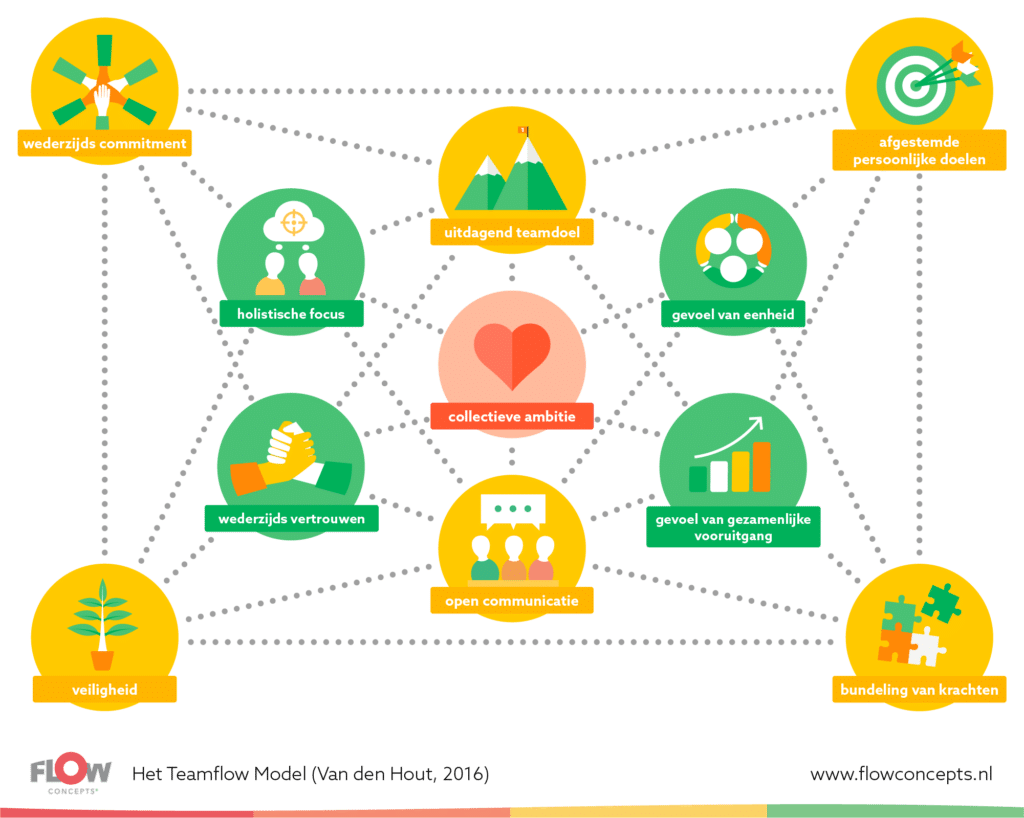
Therefore, wouldn’t it be great if professionals working together in a team engaged in a climate where the likelihood of the emergence of flow is high? We did scientific research on this and found the conditions, characteristics, and benefits of team flow. To help teams in practice build a team flow climate, we designed the Team Flow Model (see Figure 1 below) which brings together the conditions and characteristics. The Team Flow Model provides team members with a handy visual reference for what they can do to achieve team flow together. We want to emphasize that all 11 elements are interrelated in both directions, but that the model contains the key relationships that describe the process of team flow. The model acts as a talking plate, so to speak, for reflection on the tasks to be undertaken as the process of working together in itself.
What is team flow and how does one experience it?
A team is a small group of individuals with complementary skills who are committed to a common higher purpose with performance goals and an associated approach, for which they hold each other accountable (Katzenbach & Smith, 1992). If you are able to create the conditions in a team in which each individual team member can experience flow while performing his or her personal task, the likelihood of an actual team flow experience is high. Team flow is the moment when all team members experience flow together during the execution of their interdependent tasks, giving this experience its own and unique character (Van den Hout, Davis & Weggeman, 2018). It thus also refers to an optimal experience, but this time of optimal collaboration characterized by:
- Share a sense of unity with each other as if the team were one acting organism;
- Experiencing a sense of joint progress as if effortlessly building on each other, that makes team members feel as if they are a flywheel together, taking off, and performing above their abilities;
- A sense of being able to trust each other blindly and thereby having the conviction that they can accomplish the joint task together with good results;
- Having the feeling of performing the common task with a holistic focus. This means that all team members perform the personal tasks with such concentration that fully fits into the harmony and the team’s (higher) goal to be pursued.
Thus, the above four characteristics form the perception of a team flow experience. The concept of team flow can thus be described as experiencing flow during the performance of activities in the interest of the team, where the individual team member feels that the whole of which one is a part, the team dynamic, is also in a flow. This perception occurs because seven necessary conditions are present in addition to the four characteristics. These conditions are therefore also part of the experience of team flow but precede the experience of the above four characteristics. You could hence also call these seven conditions preconditions, and the four characteristics the conditions of team flow.
How does team flow occur and what are the seven prerequisites for team flow?
Collective ambition
Team flow experiences often arise with the advent of a collective ambition. A shared intrinsic motivation to form a team together and take on a common task. This can be something enjoyable, like a game of soccer, or something important, like providing good care to an indigent patient. So often, there are values behind this that are shared. In addition, collective ambition also includes the recognition of complementary qualities in the team that make people want to form a team with this very group of people. If these complementary qualities are not recognized, there is no trust in the collaboration, and no real team will form around the collective ambition.
A clear challenging common goal
If there is a collective ambition in a team, team members often jointly derive one or more shared goals that are plotted out over time. These are usually concrete results to be delivered or achieved at a certain point in time. This goal, therefore, ensures that at a particular moment, people take action together. To achieve team flow, this team goal must be concrete, challenging, but achievable for the team.
Aligned personal goals
Setting common goals also means dividing tasks. So, who does what at what time in order to achieve this goal together? In other words, a division of tasks or roles is agreed upon, or in other words, personal goals are agreed upon that all contribute to the common team goal. The presence of personal goals contributes to achieving the common goal. The established personal goals are clearly articulated, meaningful, and proprietary, in addition to providing growth and development for the individual as well as the team as a whole.
High skill integration
To be able to experience flow while performing tasks, it is important to feel positively challenged in the process. The level of challenge must be stimulating to personal qualities, skills, or competencies. One must have the feeling that he or she can handle the task, but it is allowed to be a bit exciting whether one will actually achieve this. Healthy tension, in other words, that keeps one alert and focused. For team flow, the efforts of each individual team member must also be challenging. In other words, strengths must be combined in such a way that each team member can fully deploy their strengths and synergy can be created by working together.
Open communication, positive, direct and constructive!
This brings us to the following condition: that of open communication. It must be clear to each team member involved at all times who is doing what, how one is doing personally, and how the team as a whole is doing. Feedback on one’s task, the joint task, and the collaborative process is required. This feedback is clear, constructive, and encouraging. Open communication and providing feedback reveal the contributions of all members in achieving the common goal. This allows the team to build on the interaction with each other to achieve the common goal as effectively and efficiently as possible. When this condition is met, the team can deftly (agile) maneuver on challenging or risky situations that will arise (unexpectedly).
Safety
When facing challenges or risks with each other, safety is an essential prerequisite. Each team member must feel physically, psychologically, and socially safe to perform personal tasks. To achieve this, unnecessary and unacceptable risks are excluded, but the opportunity to fail remains. After all, the joint and individual goals are set up to be challenging. For the social aspect of safety, this means that in terms of communication, it is, for the most part, positive, direct, and constructive. As a result, one also dares to take on the task psychologically and experiences less stress or fear of failure, for example. Sometimes, one may allow moments of negative expression if, for example, someone structurally fails to keep appointments and this person has already been constructively pointed out several times.
Mutual commitment
As a final essential condition, we name the establishment of mutual commitment. Taking responsibility with each other to achieve the intended common goal with dedication and surrender. One supports the other in creating and maintaining the ideal team dynamic that is formed by the presence of the team flow conditions. One does this through task-oriented coaching and by holding each other accountable. In addition, this commitment can be extended into adherence to certain principles, rules of conduct, and/or safety measures. Team members should agree with each other on those commitments that matter and ensure that a healthy, positive, and performance climate continues to exist.
Thus, if these conditions are all present, the likelihood of experiencing the four characteristics of the team flow experience is most significant. The concept of team flow can thus be described as the experience of flow during the execution of activities for the good of the team, in which the individual team member feels that the whole of which one is a part, the team dynamic, is in an optimal process-oriented collaborative flow that is simultaneously experienced as effortless, challenging and energetic.
Why should we experience team flow on a regular basis?
The description of the 11 elements of team flow already includes a number of potential benefits. Most people like a challenge, clarity, structure, things moving forward, being committed to what you are intrinsically motivated and good at. Receiving feedback from team members may be difficult at times, but if it is positive and constructive, it also provides growth opportunities. Seen this way, there are already quite a few benefits to be gained from the team flow experience itself. In our research, we have also investigated the effects of team flow in different contexts. We will certainly do additional research on this in the future. Here is a preliminary overview of the possible benefits of team flow:
Better team performance
In flow, people are completely absorbed in the task at hand, they are fully focused, and performing the task seems to come naturally. This cannot help but lead to higher-quality performance. If one reinforces the other in a team in this way, the team can greatly surpass itself. One propels the other to greater heights at both the individual and team levels. In a study of team flow within student project teams, we also found a positive relationship between team flow and the quality of their output (Van den Hout, Gevers, Davis & Weggeman, 2019).
Creativity
Some studies confirm that people act more creatively in flow. A graduate study on team flow and creativity also recently found a positive correlation (Verhoeven, 2018).
Development
In flow, the ability to learn is greater, and thus one develops oneself further in performing the task (Csikszentmihalyi & LeFevre, 1989). The presence of teammates greatly enhances this effect through the immediate possibility of task-oriented feedback. In this way, the team also corrects itself as a team, and thus development is likely to take place at both the individual and team levels.
Desire to take on new challenges together
Experiencing flow creates a desire to take on a new challenge (Csikszentmihalyi, 1990). As a team, this creates a desire for a new joint challenge that is even more intense. This is because people share the team flow experience as one of great significance and intense satisfaction. We even believe that these moments stay with us for the rest of our lives.
Positive atmosphere
If one regularly experiences team flow with others, there is a form of positive communication in the team and thus probably also a positive atmosphere in the team (Van den Hout, Davis, & Weggeman, 2018). In a study of team flow within professional teams at work as well as student project teams, we also found a positive relationship between team flow and individual happiness level (Van den Hout, Gevers, Davis, & Weggeman, 2019).
Meaningful experience
By achieving personal goals that stem from intrinsic motivation, one may experience task performance as highly meaningful. As a team, one shares this with each other, which can strengthen the experience and conviction to undertake the activity.
Satisfaction
Experiencing flow provides satisfaction; after all, the activity is intrinsically rewarding (Csikszentmihalyi, 1990; Akasawa, 2004). In team settings, one can share this feeling with each other afterwards which again may have a reinforcing and binding effect.
Happiness
It is well known that there is a positive relationship between flow and happiness (Csikszentmihalyi, 1990). In a study of team flow within professional teams at work as well as student project teams, we also found a positive relationship between team flow and individual happiness level (Van den Hout, Gevers, Davis & Weggeman, 2019). Thus, it seems that regularly experiencing team flow contributes to people’s individual happiness.
So it seems that working together in a climate where the likelihood of team flow is high is relevant and may be pursued. Keep in mind that one does not have to be in flow all the time as an individual or team. Precisely not! Flow experiences should be interspersed with moments of (self) reflection. If this is not done, the flow could turn into a number of adverse effects. More on that in a future blog. For now, we wish you all intense flow on a regular basis!
References
- Asakawa, K. (2004). Flow experience and autotelic personality in Japanese college students: How do they experience challenges in daily life? Journal of Happiness Studies, 5(2), 123-154.
- Csikszentmihalyi, M., & LeFevre, J. (1989). Optimal experience in work and leisure. Journal of Personality and Social Psychology, 56(5), 815-822.
- Csikszentmihalyi, M. (1990). Flow: The psychology of optimal experience. New York: Harper and Row.
- Katzenbach, J. R., & Smith, D. K. (1992). The wisdom of teams: Creating the high-performance organization. Boston, MA: Harvard Business Press.
- Nakamura, J., & Csikszentmihalyi, M. (2009). Flow theory and research. In C. R. Snyder & S. J. Lopez, The Oxford handbook of positive psychology (2nd Ed.), (pp. 195-206). Oxford: Oxford University Press.
- Van den Hout, J. J., Davis, O. C., & Walrave, B. (2011). The application of team flow theory. In Harmat, L., Andersen, F. Ø., Ullén, F., Wright, J., & Sadlo, G. (Eds.), Flow experience (pp. 233-247). Dordrecht: Springer International Publishing.
- Van den Hout, J.J.J (2016). Team Flow: From Concept to Application. (Doctoral Dissertation). Eindhoven University of Technology, Eindhoven.
- Van den Hout, J.J.J, Gevers, J.M.P, Davis, O.C., Weggeman, M.C.D.P. (2019). Developing and testing the Team Flow Monitor. Cogent Psychology 6:1, DOI: 10.1080/23311908.2019.1643962
- Van den Hout, J.J.J., Davis, O.C., & Weggeman, M.D.C.P. (2018). The conceptualization of team flow. The Journal of Psychology, 152(6), 388-423.
- Van den Hout, J.J.J, Davis, O.C., (2019). Team Flow: The psychology of optimal collaboration. Cham: Springer International Publishing
- Verhoeven, B. (2018) Let’s flow! Transformational leadership and team effectiveness: The mediating role of team flow in organizations . Master Thesis. Eindhoven: Eindhoven University of Technology.
Written by JEF VAN DEN HOUT
